Handwriting slant
How to see left, upright, and right slant against a baseline, and why the angle is not a reading of mood.
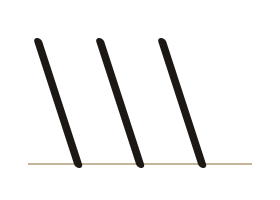 Left of vertical. The top of the stroke sits to the left of the base.
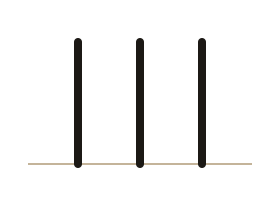 Near vertical. Downstrokes stay close to upright.
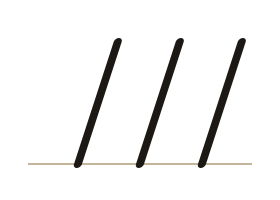 Right of vertical, the lean taught in italic and many cursive models.
Where this comes from
Right slant is built into italic and into a lot of cursive instruction. The model slants, so the student slants. Upright writing follows print and manuscript models that keep the stem vertical.
Left slant is less often the model on the page. It can come from a left-handed writer pulling the pen, from a personal drift away from the model, or from the paper sitting at an angle. The cause is not visible in the finished stroke.
What this does not show
Slant does not show whether someone is open, guarded, or future-oriented. Those are graphology claims. Controlled studies do not find that strangers can read personality from slant better than chance in any stable way.
A photo also cannot show the speed of the stroke. You can see the lean. You cannot see how fast the hand moved, and you cannot recover the pressure from a picture of the ink.
Questions
- What does handwriting slant mean?
- On this site it means the visible lean of the downstrokes: left, upright, or right. It does not mean a mood or a social style.
- How do I judge slant from a page?
- Look at the downstrokes of m, n, t, or l against the baseline or the edge of the paper. One letter is a weak sample. A row of them is enough to see the lean.
- Is right slant the correct slant?
- It is the slant of italic and of many cursive books. Upright is the slant of most print models. Left is a real outcome. None of the three is a diagnosis.
- Can slant change in one day?
- Yes. Paper angle, pen, fatigue, and the model you are copying all move it. A change in slant is not a change in personality.
- Is graphology real?
- Graphology claims that slant and similar marks predict personality. That claim is not supported well enough to use. The science page says what the evidence allows.